
The Bank Decides in a Day. Replacing It Takes Months.
A banking relationship can end in a day and take months to replace, with no explanation owed. What that asymmetry costs, and what redundancy means in practice.
 Kate Swift
 Payments
A payment does not go through. There was no letter the month before, no call, no warning that anything was under review. The transfer simply fails, and when someone asks why, the answer is that the account no longer supports this activity.
That is how most businesses learn their banking arrangement has changed. Not through a notice period, but through a payment that stops working.
The asymmetry nobody plans for
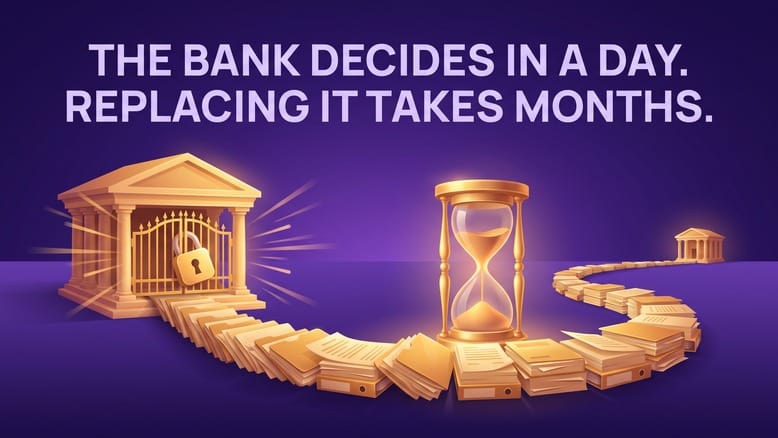
A bank can end a relationship in a day. Replacing it takes weeks, and in complicated cases months.
Those two timelines belong to the same event, and the gap between them is the whole risk. The decision arrives fully formed and takes effect immediately. The remedy requires opening a new relationship somewhere else, which means onboarding, documentation, ownership structure, source of funds, and a queue you enter at the back.
There is a second asymmetry on top of it. A compliance function is under no obligation to explain its reasoning, and generally will not. A business that would happily fix the problem is not told what the problem was. It cannot correct a file it has never seen, or argue with a category it does not know it has been placed in.
So the practical position is this: an outcome you cannot appeal, delivered without notice, with a recovery time measured in weeks, and no diagnosis to work from.
Why banks behave this way
It is tempting to read the decision as a judgement about a specific company. It usually is not.
De-risking operates on categories rather than on individuals. A bank prices the cost of supervising a type of client, a type of corridor, a type of activity, and when that cost stops justifying the revenue, the relationship goes. A clean company with complete paperwork can be exited on exactly the same logic as a problematic one, because the assessment was never really about it.
This is not a new or local phenomenon, and it is measurable. The Bank for International Settlements tracks the number of active correspondent banking relationships worldwide, and that number fell by almost 30% between 2011 and 2022. Over the same stretch, the value of cross-border payments kept growing. Fewer relationships carrying more volume is a concentration, and concentration is another word for fragility: the same flows now depend on fewer decision-makers, each of whom can withdraw without explaining why.
The steepest reductions have fallen on regions already least served, which is why the effect shows up first in businesses that trade across those corridors.
What actually breaks
The instinctive worry is payroll, and payroll is genuinely exposed. But in practice the damage is rarely confined to one thing, because a business with one banking relationship routes everything through it.
Incoming customer payments stop arriving. Outgoing supplier payments stop leaving, and suppliers who were relaxed about terms stop being relaxed. Refunds cannot be issued. And then the part that is hardest to repair: contractual obligations with payment dates attached come due, and there is no mechanism to meet them.
A missed transfer is an operational problem. A missed contractual milestone is a commercial one, and it outlives the banking issue that caused it. Counterparties remember. Some of them write clauses about it afterwards.
What redundancy actually means here
The uncomfortable arithmetic is that a replacement relationship takes weeks to establish, and the moment you need one is precisely the moment you cannot start.
Redundancy therefore has to be built while nothing is wrong. That means more than one banking relationship, opened and kept warm before there is a reason to use them, with enough genuine activity that the account is not dormant when it matters. It means more than one settlement route, so that a single institution's risk appetite does not determine whether the business can transact at all. It means knowing, in advance, which payments would move where.
None of this is exotic. It is the same discipline any operations function applies to a supplier that could fail, and banking is rarely treated with the same seriousness, because the assumption that a bank relationship is permanent is very hard to shake until the first time it is not.
The test is simple enough to run today. If your primary banking relationship ended this afternoon, without notice and without explanation, what would still work tomorrow morning? If the honest answer is nothing, the exposure is not theoretical, and the time to fix it is while the answer is still hypothetical.
That gap between how fast a banking relationship can end and how slowly one can be built is the part of the system Stablegate works in.
Published for general information and education only. Not investment, financial, legal, or tax advice, and not an offer or solicitation in any jurisdiction. This is not marketing - Stablegate does not market its services to persons in the EU/EEA, the UK or the US (Restricted Persons).
The views expressed are current as of the publication date and may change. Third-party quotes are attributed and used under applicable quotation exceptions. Sourced and first-party data has not been independently verified and is provided without warranty. Any forward-looking statements are illustrative only. Past performance is not indicative of future results.
STGG AG is not a MiCA crypto-asset service provider (CASP) and does not offer or onboard services to Restricted Persons via this hub. Any service relationship arises only away from this hub, at the client's own exclusive initiative.
Kate Swift
Kate writes on Stablegate's stablecoin settlement infrastructure and how banks are adapting to on-chain rails.
Related articles
 Payments
The Cost of a Cross-Border Payment Is Not the Fee
A transfer crosses four institutions before it is usable, and the conversion spread costs more than the wire fee everyone argues about.…
 Payments
Who Answers the Bank's Questions When You Buy Property With Crypto
Crypto-funded property deals stall when the bank's question about source of funds arrives late and nobody prepared the answer. Who handles…
 Payments
Luxury Buyers and Crypto: Where the Money Is Going in 2026
HNWI wealth reached USD 98.3 trillion, yet alternatives fell to 12% of portfolios while two in three holders want more. Where that gap…