
The Cost of a Cross-Border Payment Is Not the Fee
A transfer crosses four institutions before it is usable, and the conversion spread costs more than the wire fee everyone argues about. Where the money actually goes.
 Kate Swift
 Payments
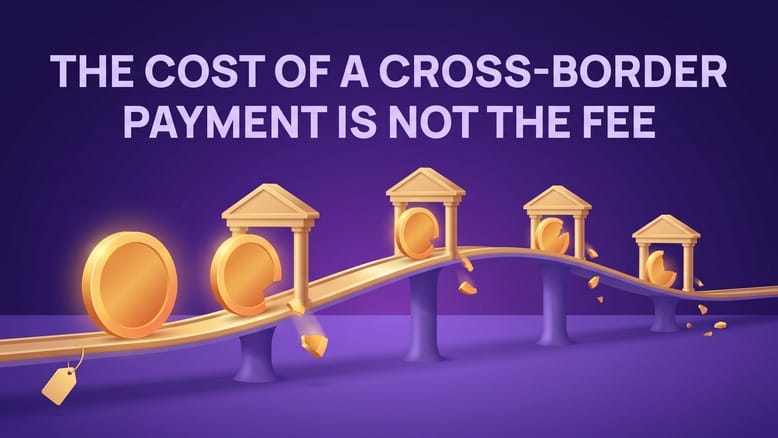
Ask a finance team what it costs to send money from Singapore to Europe and you will usually get a number from a fee schedule. That number is real, and it is the smallest part of the answer.
The larger part is spread across a route most senders never see, and priced in a way that does not appear on any invoice.
What the payment actually does
A transfer sent in the sender's local currency does not travel from one bank to another. It moves through a sequence, and each step is a separate institution with its own hours, its own queue and its own checks.
It leaves the sending company's bank. It clears through the domestic system on that side. Somewhere in the middle it is converted, because the sender's currency is not the currency the beneficiary will receive. It then enters the clearing system on the receiving side, and finally reaches the beneficiary's bank, which decides whether to credit it.
Four institutions, give or take, before the money is usable. None of them is coordinated with the others, and each can hold the payment for reasons the sender is not told. A cut-off time missed at the first step pushes everything behind it by a day. A query raised at the last step can hold the money after every other party has already done its job.
This is why cross-border timing is so hard to predict. The delay is not one queue. It is the sum of several, and the variance compounds rather than averages out.
The part that is not on the invoice
Then there is the conversion, and this is where most of the money goes.
An FX margin is not charged as a fee. It is built into the rate applied at the moment of conversion, which means it is arithmetically invisible to the payer. A fee can be compared, questioned and negotiated. A rate can only be compared against the mid-market rate at the exact moment the conversion happened, which almost nobody reconstructs after the fact.
The result is that businesses routinely believe a transfer cost them a fixed fee, when the spread on the conversion was several times larger. On a single payment the difference is an irritation. Across a year of supplier payments in a currency you do not hold, it becomes a line item that was never budgeted because it was never visible.
The wire fees that do appear are the part everyone argues about, and the part that matters least.
What settling in the destination currency changes
This is the practical case for stablecoins denominated in something other than dollars.
The dollar sits in the middle of an enormous share of cross-border flows, including flows between two parties who neither hold dollars nor want them. A payment from Asia to Europe frequently converts twice, once out of the local currency and once into euros, because the dollar leg is the route the correspondent network is built around. Each conversion carries its own spread.
A euro-denominated stablecoin removes that detour. Value moves on a settlement layer that does not care about geography or banking hours, and it arrives denominated in what the recipient actually needs. The intermediary chain shortens because fewer institutions are required to pass value between two currencies.
The structural pressure behind this is real: the number of active correspondent banking relationships worldwide fell by almost 30% between 2011 and 2022, according to data tracked by the Bank for International Settlements, while cross-border payment volumes kept rising. Fewer institutions are carrying more flow. Routes that depend on long correspondent chains are getting thinner, not thicker.
What it does not change
It would be dishonest to stop there, because the chain shortens at the middle and not at the ends.
The money still has to enter the banking system at the destination, and the receiving institution still has to accept it. That acceptance is a compliance decision about origin, and it is the same decision whether the value arrived through four correspondents or through a settlement layer. A shorter route removes hops, queues and spread. It does not remove the review at the end, and any description of this technology that suggests otherwise is selling something.
What changes is the size and visibility of the cost. What stays is the question of whether the receiving bank will take it.
For a business paying suppliers in a currency it does not hold, that trade is usually worth making. Stablegate works on the part of it that sits between the settlement layer and the bank at the far end.
Published for general information and education only. Not investment, financial, legal, or tax advice, and not an offer or solicitation in any jurisdiction. This is not marketing - Stablegate does not market its services to persons in the EU/EEA, the UK or the US (Restricted Persons).
The views expressed are current as of the publication date and may change. Third-party quotes are attributed and used under applicable quotation exceptions. Sourced and first-party data has not been independently verified and is provided without warranty. Any forward-looking statements are illustrative only. Past performance is not indicative of future results.
STGG AG is not a MiCA crypto-asset service provider (CASP) and does not offer or onboard services to Restricted Persons via this hub. Any service relationship arises only away from this hub, at the client's own exclusive initiative.
Kate Swift
Kate writes on Stablegate's stablecoin settlement infrastructure and how banks are adapting to on-chain rails.
Related articles
 Payments
The Bank Decides in a Day. Replacing It Takes Months.
A banking relationship can end in a day and take months to replace, with no explanation owed. What that asymmetry costs, and what…
 Payments
Who Answers the Bank's Questions When You Buy Property With Crypto
Crypto-funded property deals stall when the bank's question about source of funds arrives late and nobody prepared the answer. Who handles…
 Payments
Luxury Buyers and Crypto: Where the Money Is Going in 2026
HNWI wealth reached USD 98.3 trillion, yet alternatives fell to 12% of portfolios while two in three holders want more. Where that gap…